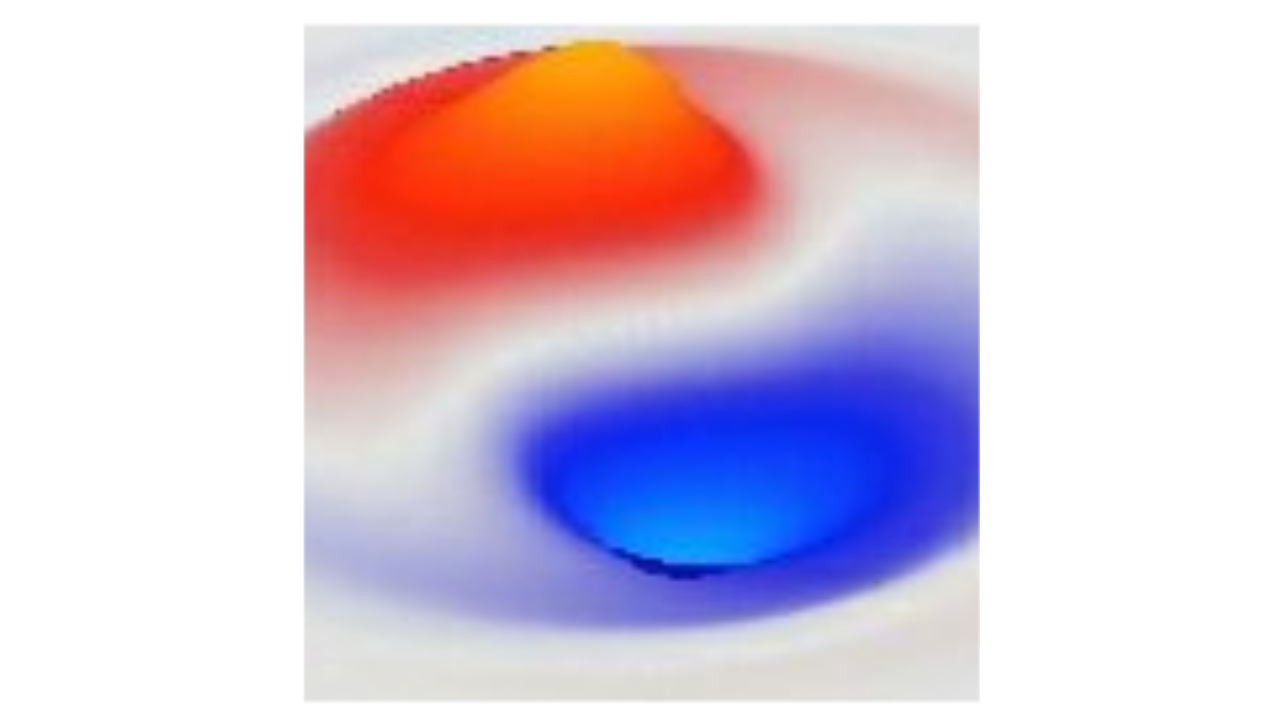
In the classical worldview, people believed that electromagnetic (EM) radiation, described by Maxwell’s equations (which represent one of the crowning achievements of the classical era), propagated throughout space via the luminiferous aether — some kind of mysterious, all-pervasive substance that provided a physical model for the phenomena described by Maxwell’s equations. The classical worldview was thus dominated by the intuitively satisfying notion that local, deterministic physical laws, operating autonomously through some kind of real physical medium, could produce the observed behavior of nature. This is essentially identical to the cellular automaton (CA) framework described above.
One harbinger of the end of the classical field model was the famous Michelson-Morley experiment of 1887, which is widely regarded as disproving the existence of the aether. This experiment used patterns of interference from light beams traveling in different directions to test for any differences in the speed of light as a function of the relative motion of the Earth through the aether. The idea was that if the aether is a fixed medium for light, the Earth must be moving in some direction relative to this fixed medium (as a result of its orbit around the Sun, and the Sun through the galaxy, etc), and this difference should thus be measurable in terms of the differential speed of light in different directions. The experiment revealed no such differences — light always travels at the same speed in every direction \((c \approx 3.0*10^8)\).
However, it remains remarkably under-appreciated to this day that special relativity is entirely compatible with the notion of a luminiferous aether, and indeed provides exactly the right explanation for why the Michelson-Morley experiment failed to detect it: because the speed of light is a constant, the lengths of objects must actually contract in their direction of relative motion, and time dilates, so that even if you are racing very close to the speed of light, almost keeping up with a speeding light ray, you measure the speed of this light to be the same as someone standing still.
Specifically, because your measuring devices (rulers) have all shrunk in the direction of motion, distances appear longer, and time dilation causes measured time intervals to appear shorter, with the net result that a moving observer obtains the same measured distance per unit time (i.e., speed) that someone standing still would measure. This Lorentz transformation was already well established prior to Einstein’s 1905 paper on special relativity, based on measurements of electromagnetic phenomena.
As shown by the Klein-Gordon equation, a simple wave equation with a mass term results in waves that can travel at any velocity below the speed of light, in proportion to the wavelength of the wave. This relationship between wavelength and speed is exactly as required by the Lorentz contraction (and the core quantum relationship between momentum and frequency), where distances would be measured as a function of these contracting wavelengths.
Thus, we only need to modify our understanding of the properties of the aether, in accordance with the Lorentz transformation, to reconcile the appealing classical world view with the observed facts. But there are two obvious problems with such an approach. First, the aether becomes essentially unmeasurable, and thus a belief in its existence would seem to be outside the scope of objective science. Second, the framework of special relativity has no need for such a thing, and relativity provides such a nice compelling and self-contained world view, that there is no motivation to retain this clunky, outdated notion of the aether.
However, if we can develop a compelling and accurate physical model of electrodynamics based on the CA framework, with the central property that the discrete CA state cells provide the basis for the discrete massive particles in the pilot-wave framework, then at least there would be no basis to reject such a framework outright.