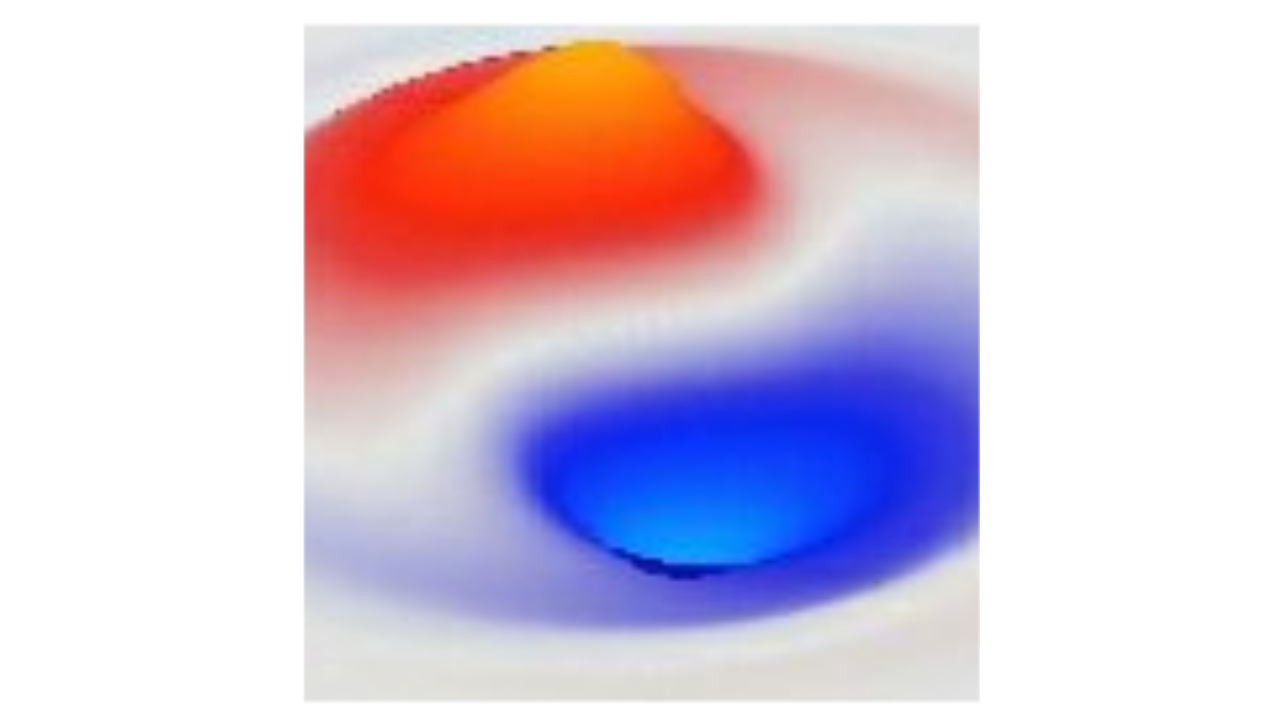
Figure 1:
Illustration of the de Broglie-Bohm pilot wave framework, where a physically-real quantum wave exerts forces (based on the wave gradient) on the corresponding particle, which has a well-defined 3D position and momentum at all points in time. To be compatible with standard quantum physics the quantum wave is taken to be identical to the standard theory, in high-dimensional configuration space.
Figure 2:
The hydrodynamic pilot wave system discovered by Couder et al. (2005) and explored extensively by J.M.W. Bush and colleagues (e.g., Bush et al., 2024). A small oil droplet plays the part of the particle, with a bidirectional interaction between it and the underlying water medium. This classical physical system has been used to reproduce a wide range of quantum phenomena, including even a static version of the Bell inequality system that demonstrates the non-locality of quantum physics.
The initial understanding of the quantum wave in the 1920’s by both Erwin Schrödinger and Louis de Broglie was as some kind of physically real wave that exerts forces on particles. Schrödinger apparently discarded this notion but de Broglie did not (Broglie, 1923; Broglie, 1926; Bacciagaluppi & Valentini, 2009). After roughly 30 years, David Bohm picked up this thread to develop what is now known as the de Broglie / Bohm pilot wave theory (Bohm, 1952; Bohm, 1952; Bohm & Vigier, 1954; Bohm & Hiley, 1975; Holland, 1995). Figure 1 shows a cartoon of the essential idea, where the gradient of a physically-real quantum wave function drives the motion of the associated particle.
Figure 2 shows a purely classical, physical realization of this framework in the form of an oil droplet bouncing on top of a water wave of its own creation, which can reproduce a wide range of quantum phenomena consistent with the pilot-wave framework (Couder et al., 2005; Bush & Oza, 2021; Bush et al., 2024 – see this YouTube video for demonstrations).
Interestingly, this system has a double solution character where the particle directly drives its own associated wave, vibrating at the Compton wavelength based on the rest mass and momentum of the particle (planck-relation), which then influences the trajectory of the particle. This corresponds more directly to the intuitive model that de Broglie envisioned all along (Broglie, 1926; Broglie, 1956; Broglie, 1960; Broglie, 1970; Broglie, 1987; Colin et al., 2017; Drezet, 2021). By contrast, the Bohmian version only has a unidirectional effect of the wave on the particle, which has critical implications for the epistemic vs. ontological components of the wave function, as discussed below.
Because this Bohmian version of the theory uses the exact same Schrodinger wave equation operating within non-local, high-dimensional configuration space as the standard quantum theory, it ends up making exactly the same predictions as the standard theory. Unfortunately, this lack of distinctive predictions allows many to immediately dismiss the theory, even though it makes an extremely valuable contribution in providing a clear physical model of a genuine wave-particle duality with physically-real waves and particles. Furthermore, it also represents a different type of calculational tool that provides at least one critical step toward a universal basis space representation, by showing that the particle locations can actually be well-defined at all times, without violating any of the other core assumptions of the standard theory.
In effect, the pilot-wave theory shows that position space is privileged, and, at least for position measurements, completely avoids the otherwise inexplicable nature of the collapse of the wave function at the point of measurement, which is perhaps the single most difficult to understand aspect of the standard Copenhagen interpretation. This point is magnified considerably by subsequent work that argues that every quantum measurement ultimately reduces to a position measurement (Bell, 1982; Dürr et al., 2004; Daumer et al., 1996).
Intuitively, this makes sense in terms of a pointer on a dial, or the trace of a particle through a bubble chamber / particle detector, which inevitably show discrete particle trajectories consistent with particles discretely colliding and decaying into other particles at entirely specific, localized points within the overall trajectory. Although a purely wave-based, configuration-space framework can be used to compute such trajectories (Mott, 1929; Figari & Teta, 2013), the pilot-wave model provides an explicit physical model that directly aligns with this observed phenomenology. Furthermore, you can simply include the measurement apparatus as one of the elements in your configuration space, to get specific predictions about the position of a needle or other readout device (Barrett, 2021).
On the one hand, this is a startling result from the Copenhagen perspective: all that crazy stuff about reality not existing until you measure it can just be dispensed with entirely. However, many scientists, including Einstein, rejected Bohm’s new pilot-wave theory specifically because of its use of the high-dimensional configuration space (Norsen et al., 2015). Why did they not similarly complain about the exclusive use of this same objectionable device in standard QM frameworks? Or in standard classical Hamiltonian applications?
The answer is evidently that, unlike these other applications, the pilot-wave framework strongly requires that the quantum wave function is somehow a real thing! It must actually influence the real trajectories of particles as they move through space, and thus it must actually be something real itself. But the contrary idea that somehow exponential configuration space is necessary to calculate the predictions of quantum mechanics, and yet it is somehow not reflecting something real about how physics actually works, represents a rather selective use of the calculational tool logic. This logic does not allow one to completely ignore the idea that some other framework must somehow account for the behavior being accounted for by the calculational tool!
Concretely, if there is an actual interference effect being observed (e.g., in the double-slit experiment), there must be an actual cause of that interference effect, and that cause cannot just be wished away with a bunch of vague platitudes about complementarity principles etc. Critically, the double-slit case cannot be explained on purely epistemic grounds, e.g., due to a lack of knowledge about the starting conditions of a particle. Instead, it requires some kind of wave to go through both slits, to drive the interference effects.
Epistemic vs. ontological wave components
The issue of the epistemic vs. ontological aspects of the wave function as represented in the standard Schrödinger equation is critical for understanding the difference between the Bohmian vs. de Broglie double solution versions of the pilot wave model. See epistemic for general discussion and references to relevant literature (e.g., Pusey et al., 2012, Ringbauer et al., 2015): this is a major issue for understanding quantum physics very generally, beyond the specific pilot wave framework, which nevertheless provides a particularly clear window into the underlying issues.
In the standard application of the Bohmian pilot wave framework, the final positions of the particles represent the predicted outcome of an experiment, and, critically, you have to perform many different runs of an experiment to collect the aggregate statistics. Each run starts with the particles in randomly-distributed locations, according to the probability distribution derived from the Schrödinger wave function. This reflects a fundamental epistemic lack of knowledge about starting states, due to the Heisenberg uncertainty principle, which ultimately derives from the contextual nature of the quantum world: we cannot measure the state of the system without irrevocably altering this state.
The central problem with the Bohmian framework is that the Schrödinger wave function is also used to guide the time-evolution of the discrete particles, and this wave function includes a significant epistemic component. For example, the wave inevitably spreads out over time, reflecting a growing uncertainty since the last measurement took place. Why should an epistemic wave be pushing real particles around?
The double solution framework resolves this problem in principle, because the wave itself is continuously being generated by the particle, thereby keeping the wave field localized and preventing the diffusion over time. Unfortunately, de Broglie was unable to formulate this idea in a way that recovers the Schrödinger equation as an aggregate description of the combined epistemic + ontological wave components, and neither has anyone else since then, despite continued efforts (Dagan & Bush, 2020; Durey & Bush, 2020; Darrow & Bush, 2024; Shinbrot, 2019; Borghesi, 2017; Andersen et al., 2015; Sutherland, 2019; Drezet, 2023). Nevertheless, these approaches explicitly describe the properties of ontological waves generated by the particle, as distinct from the epistemic properties, and thus provide a useful direction toward unscrambling these components.
Bohmian formulation
The Bohmian version of the pilot-wave framework can be expressed succinctly in terms of the guidance equation, which states that the velocity of a particle is a function of the gradient of the local quantum wave function:
\[ \frac{d x(t)}{d t} = \frac{\hbar}{m} \, \mathrm{Im} \left( \frac{\psi^*_t \nabla \psi_t}{\psi^*_t \psi_t} \right) \]
where \(\psi_t\) is the Schrodinger wave function at time \(t\), \(m\) is the particle mass, and \(\nabla\) computes the local spatial gradient as described in wave.
There are a number of obvious problems with this formulation, which it inherits by virtue of being based on the non-relativistic Schrödinger framework. For example, it clearly reveals the conflict between special relativity and the simpler Schrödinger framework (Dürr et al., 2014; Norsen, 2011). Specifically, Eq 1 specifies that the local velocity of each particle is a function of the full non-local exponential configuration state space, potentially of every particle in the universe. This coupling of a local, physically real variable directly to the full wave state is not required in the standard framework, which allows it to evade these logical difficulties more easily (Norsen, 2011).
It has been difficult to derive a version of the pilot-wave model that is compatible with relativistic field theory, for example because of the need to account for the creation and annihilation of particles. How exactly does a given particle get associated with a specific element of the high-dimensional configuration space in the Schrödinger picture? Overall, in their extensive discussion of this issue, Dürr et al. (2014) conclude:
Thus, if Bohmian mechanics indeed cannot be made relativistic it seems likely that quantum mechanics cannot either.
In short, it quickly becomes clear that the Bohmian formulation is really just another calculational tool, with many unexplained and problematic features relative to the kind of universal basis, complete physical model that one might otherwise hope to find. This includes the integration of both epistemic and ontological elements into a single overall Schrödinger wave function. Nevertheless, it still represents a tremendously valuable advance in providing a vastly more physically plausible interpretation of quantum physics than the standard Copenhagen model.
The hydrodynamic model
The hydrodynamic model of the pilot-wave framework (Figure 2, known as HQA = hydrodynamic quantum analogs) has provided a particularly compelling demonstration that so many of the seemingly puzzling phenomena in quantum physics can be explained in terms of an entirely classical, macroscopic, intuitively-understandable pilot-wave system. As summarized by Bush et al. (2024) (p. 125):
The theory of quantum mechanics is undoubtedly nonlocal. HQA is questioning the extent to which quantum physics need be nonlocal. Quantum nonlocality would appear to be ubiquitous, manifest everywhere from wave-function collapse to statistical projection effects to slit diffraction, from surreal trajectories to the Elitzur–Vaidman bomb tester. HQA has made clear that all these phenomena, at least, can be understood from a local realist perspective.
What remains to be explained are really the Bell’s inequality tests of quantum non-locality. There is already an HQA model of the static version of such a test (Aspect et al., 1982), which explains the non-local effects in terms of the wave reflecting the stable structure of the detectors (Papatryfonos et al., 2025). Given the extreme difficulties associated with non-locality and the basic requirements of a universal basis representation for physics, and the increasingly limited scope of phenomena that non-locality is needed to explain, it is not unreasonable to therefore be motivated to find other ways of accounting for these phenomena.
In this respect, one notable feature of the HQA models is that they are both non-linear and non-Markovian, in that the wave is a double solution (per de Broglie) that is strongly influenced by the particle, and vice-versa, with evidence of significant path-based memory emerging in the wave field (Eddi et al., 2011; Bush et al., 2024). This property violates many standard assumptions in various analytical treatments of non-locality and the exponential configuration space (e.g., Montina, 2008; Sciarretta, 2018; Sciarretta, 2021).
Soliton solutions
The original, intuitively-appealing idea that Louis de Broglie started with was actually a purely wave-based ontology, where the particle-like aspect emerges naturally as a soliton configuration of a wave field (Colin et al., 2017; Drezet, 2021). A soliton is a stable disturbance in the wave field that remains localized over time, and it requires nonlinear dynamics. At the time when de Broglie was working, little was known about solitons. However, there are still various challenges with such a framework, as reviewed extensively in Colin et al. (2017).
Nevertheless, it does seem likely that some form of nonlinearity is required to create an interacting double solution pilot wave framework, which then represents a major departure from the analytical simplicity of the linear Hilbert space and Schrödinger equation. But the idea that something as simple as Eq 1 could magically provide a novel yet completely accurate theory seems to be a bit of wishful thinking. In this context, the Spinfield Model approach is to leverage other distinctive features of the Standard Model, such as the nature of the weak force, along with the cellular automaton framework, as constraints to inform and shape the exploration of the large space of possible nonlinear mechanisms.
Relativistic Lagrangian formulations
A growing number of different authors have provided alternative formulations of pilot-wave dynamics based on the Lorentz invariant Lagrangian framework that is used to define the Standard Model. This framework allows one to specify separate terms for the free evolution of distinct wave fields, along with additional terms that specify the coupling interactions between the fields. Thus, one wave field specifies the quantum wave, while the other specifies the particle properties using a suitable field-like expression, potentially allowing a de Broglie-style double solution, bidirectional interaction between the wave and the particles.
The approach by Holland (2020) maintains the use of the Schrödinger non-relativistic equation, while providing a more integrated mathematical framework that puts the wave and particle into a single overall equation. Sutherland (2019) developed a series of relativistic Lagrangian models (Sutherland, 2015; Sutherland, 2017) that use a distributed charge density function to define a probabilistic model of particle trajectories. This density function avoids the mathematically difficult singularity associated with discrete particles, but it is unclear exactly what is gained overall in this formulation.
The most radical departure from the Bohmian style model is given by Darrow & Bush (2024), building on earlier efforts (Dagan & Bush, 2020; Durey & Bush, 2020). They provide a de Broglie-style double-solution model based on a relativistic Lagrangian framework, which is specifically characterized as a preliminary attempt, not intended to capture known quantum behavior. To deal with the singularity issue of discrete particle locations, they use an intermediate spherical smoothing function that is then logically integrated down to a radius of 0. They describe numerical simulation results of their model that demonstrates a number of interesting properties in the way that the particle and wave interact.
For example, the particle is able to entrain a Compton-wavelength wave packet envelope that follows the particle around, related to the high-frequency zitterbewegung phenomenon, much as in the illustration above (Figure 1). This wave packet thus avoids the dispersion that is characteristic of the epistemic aspect of wave functions, as discussed above. A further development of this model, using a phase-based coupling between particle and wave instead of an amplitude-based coupling, was shown to produce the Bohmian version of the pilot-wave framework (Darrow, 2025), thereby providing a key bridge between these frameworks.
Thus, this model provides a starting point for exploring the large space of non-linear, emergent dynamics that can arise when the particle and wave fields are given more interesting dynamical properties. It appears to coincide with many aspects of the Spinfield Model, and a detailed comparison between the two is needed.