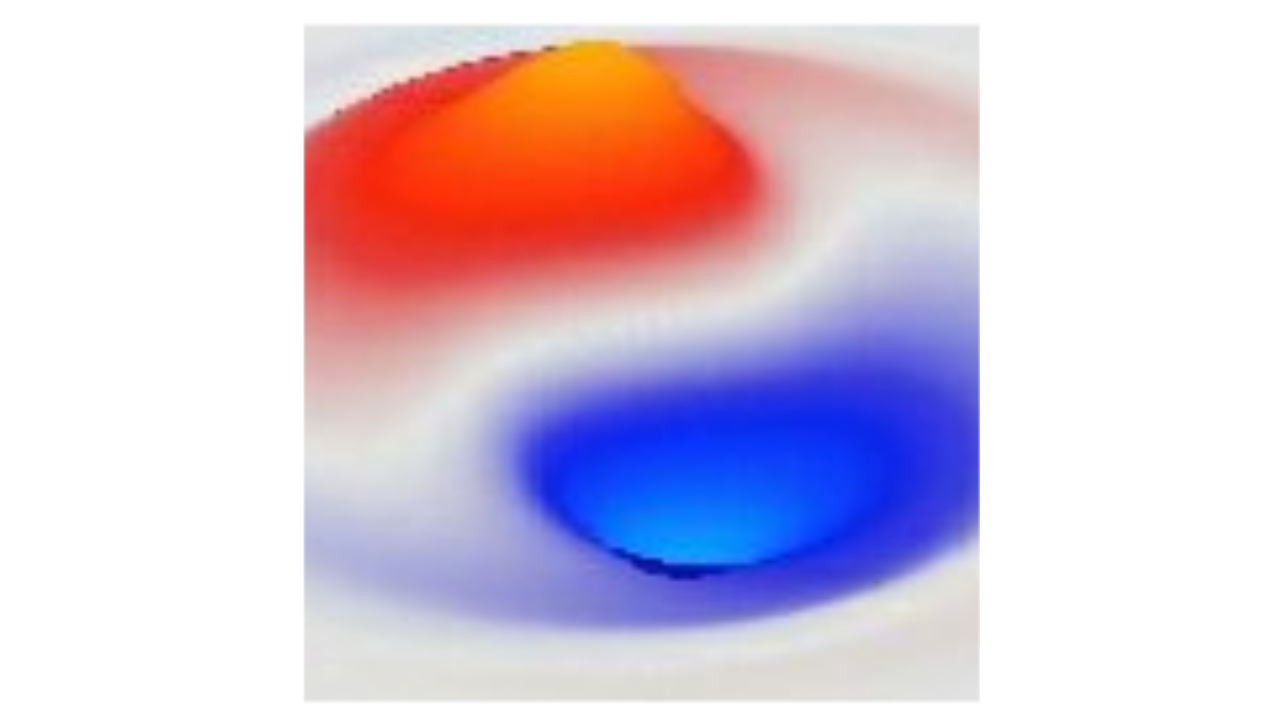
There are various interpretations of the phenomenology of quantum physics, which ultimately represent an attempt to articulate a physical model of what is “actually going on” in Nature. This page provides a brief narrative and links to other pages that discuss these interpretational issues.
The distinction between calculational tools vs physical models is central to the approach here, as discussed in the Overview. It seems that many sources of confusion arise from trying to make physical sense of something that might otherwise be recognized as a convenient mathematical tool for computing answers to specific kinds of physics problems.
A relatively clear example of such a calculational tool is the Coulomb gauge representation of electromagnetic (EM) fields (i.e., Maxwell’s equations), which uses an action-at-a-distance \(1/r^2\) equation for computing the electric force between charged particles. By contrast, the Lorenz gauge representation shows how this inverse-square force law can emerge as a consequence of wave propagation, in a way that is fully compatible with the constraints of special relativity and local, neighborhood interactions. These two representations are mathematically equivalent, but it seems clear that one would choose the Lorenz gauge as a physical model for how Nature actually works, even as one might frequently use the Coulomb gauge to perform actual calculations.
Two of the most important issues that different interpretations wrestle with are the apparent non-locality of quantum physics, and the status of the exponentially-large configuration space (which is also manifestly non-local) that is used in most mathematical frameworks, including the pilot-wave framework. Each of these effectively invalidates any attempt to develop an intuitively appealing physical model along the lines of the Lorenz gauge version of EM and general relativity. This can be concretely understood in the context of the cellular automaton (CA) framework, which provides a recipe for constructing a universal basis space representation that can be used without reconfiguration to represent any physical situation.
The conflict between quantum physics and gravity is widely recognized as the single greatest unsolved problem in physics today, and despite many years of trying, it is not clear that significant progress is being made. The issues of non-locality and the exponentially-large size of configuration space are central to the conflict between these two strongly validated frameworks, along with the potential existence of a high-energy (ultraviolet) cutoff in the total energy within the quantum state.
Copenhagen
We start at the beginning with the Copenhagen interpretation of QM, developed by Niels Bohr and Werner Heisenberg in the 1920’s (see history), which is the source of most of the apparent paradoxes and conundrums associated with quantum physics. At the heart of this is the interpretation of the wave function as a purely epistemic, non-physical entity. If it is not actually real, then it isn’t subject to the kinds of constraints that we might otherwise expect it to have, like being local in space and time, which is required by the well-established phenomena of special relativity.
The central premise of the Copenhagen interpretation is that there is a special kind of process called measurement that somehow causes quantum wave functions to collapse down to a single point, with the wave function defining the probability of finding a discrete particle at any given point. Exactly how a potentially widely-distributed wave might somehow gather up all of its far-flung bits and shrink down into one randomly-chosen point, in an instantaneous, manifestly non-local process, is entirely beyond the explanatory scope of the theory.
In the face of these kinds of obviously non-physical aspects of this framework, the standard answer is to “shut up and calculate”. This is the hallmark of a calculational tool, and as such, it seems prudent to consider this framework as such, and we will not spend any further effort here probing its fundamental strangeness.
And yet, the Copenhagen interpretation remains the most popular interpretation according to informal surveys of working physicists (Tegmark, 1998; Schlosshauer et al., 2013). The next-most popular interpretation after Copenhagen according to those surveys is the many-worlds interpretation (MWI) originated by Everett (1957), which postulates that the entire universe splits at each measurement event. This nominally avoids the need for wave function collapse, but at what cost? An infinite accumulation of new universes spawning everywhere? This is so completely physically implausible that it just defies belief that so many people could even contemplate such a theory, even though it does elide the otherwise thorny issue of the measurement problem (by avoiding it entirely, rather than providing some kind of positive solution).
Relatively few / none of the respondents in these surveys endorsed the pilot-wave approach, despite the fact that it eliminates most of the strange paradoxes and counterintuitive ideas advanced in the more widely-accepted interpretations. A common objection to the pilot wave framework is that it is defined over configuration space, which grows exponentially in the number of particles. However, every other framework is also defined over configuration space, or it just pushes this exponential explosion into the forking of new universes in the case of the many-worlds framework.
In effect, the other interpretations merely avoid confronting the difficulties of this exponential configuration space by denying its reality in one way or another, while still requiring it to calculate how the physics actually works. Indeed, the entire foundation of the Copenhagen interpretation is willful denial of reality: reality doesn’t exist until it is somehow “measured”. And there is no explanation for what actually constitutes a measurement, and how instantaneous collapse could possibly be made compatible with special relativity.
From this perspective, the single most important unsolved problem in quantum physics is to eliminate the configuration space representation, and somehow derive a fully relativistic and local wave-particle duality where the correlational interactions between particles that are otherwise captured in the calculational tool of configuration space naturally emerge. This new framework may well require superluminal, but still finite, wave propagation speeds for the quantum waves. It is not clear that the various existing “no-go” theorems such as Bell’s inequalities fully exclude this broader space of possible mechanisms (Das Bhowmik et al., 2021; Harrigan & Spekkens, 2010; Laidlaw, 2026).
There are also important questions about the origin of the apparent randomness present in quantum theories, which is captured by the Born probability rule within the Copenhagen framework. For example, Einstein famously rejected quantum mechanics because he thought that “God does not play dice with the universe”. Interestingly, there is a strong argument that a form of stochastic motion is necessary to accomplish isotropic motion within the constraints of the discrete-space CA framework. It is also unclear to what extent this form of randomness might interact with the correlations evidenced by entanglement, and / or the non-locality results based on Bell’s inequalities.
Pedagogical presentation
Following from the above background (including linked pages above), the following is a suggested sequence of how to proceed through the various interpretational issues:
• Contextual variables, as contrasted with “real” variables, and their role in understanding the phenomenology of QM.
• The Non-locality of quantum physics, which presents perhaps the single greatest barrier to developing an intuitively-appealing physical model, and which is manifestly in conflict with the cellular automaton framework.
• The issues and debate surrounding the configuration space framework, which automatically builds in non-locality, but at the intractable cost of an exponentially large space.
• Semiclassical models, that combine a classical treatment of the EM field according to Maxwell’s equations, with a quantum treatment of the electron.
• QED provides an overview of quantum electrodynamics which provides a highly accurate description of the relevant phenomenology of interest. However, we argue that QED is a calculational tool, not a plausible physical model.
• The Zero-point field and stochastic electrodynamics which provides an alternative formulation of QED, with which the present framework shares some important similarities.
• The concept of a luminiferous aether, which was theoretically disproven by the famous Michelson-Morley experiment of 1887, but in fact is entirely consistent with a privileged reference frame as required by the CA framework, as long as that reference frame obeys the critical time / space distortion properties of special relativity (which of course it must, to be consistent with well-established empirical data).
Pages
- • Aether
- • Bell
- • Calculational tool
- • Cellular automaton
- • Challenges
- • Configuration space
- • Contextual
- • Copenhagen
- • Double slit
- • Duality
- • Epistemic
- • History
- • Matter wave
- • Mechanisms
- • Non locality
- • Particle
- • Pilot wave
- • Quantum computing
- • Quantum wave
- • Semiclassical
- • Uncertainty principle
- • Universal basis
- • Zero point
- • Zitterbewegung