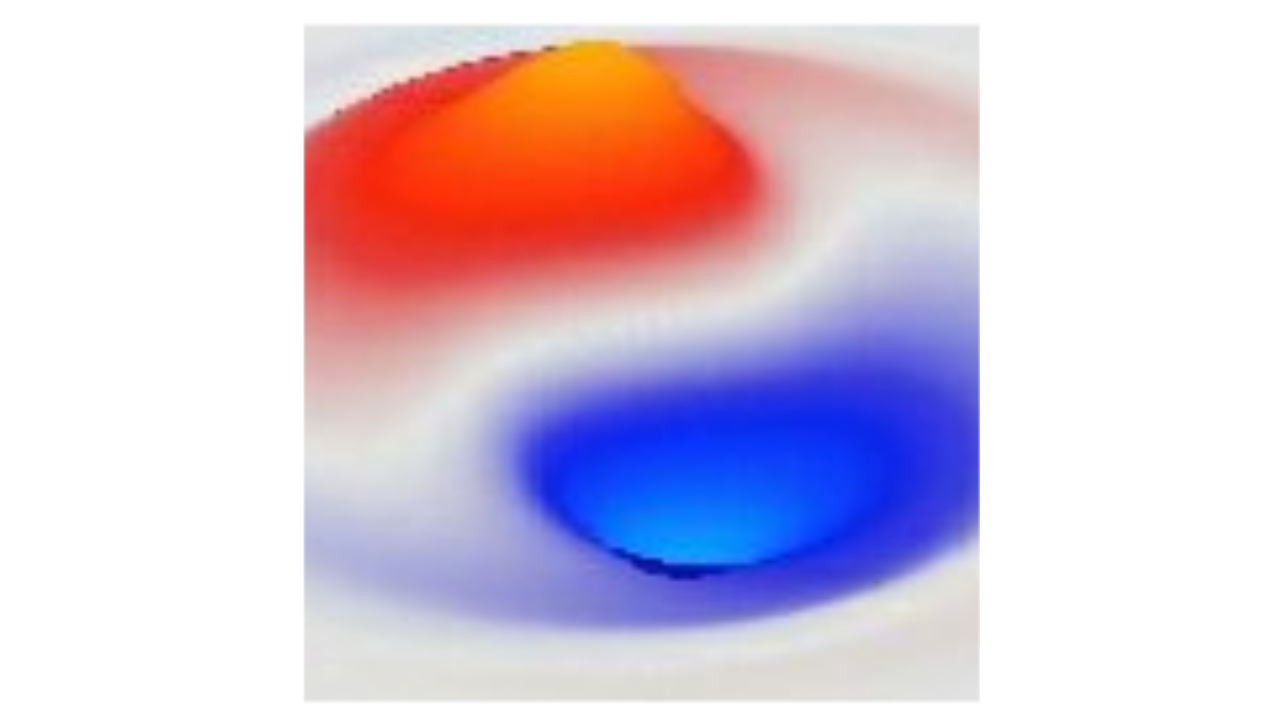
Historically, matter has typically been conceived of as something hard and solid: a particle of some form or another. However, it is also possible to produce many of the known properties of matter using a very simple extension of the simple second-order wave equation, in the form of the Klein-Gordon (KG) wave function.
Figure 1:
A wave packet, which is a spatially localized wave disturbance that propagates through space as a coherent entity. This could serve as a model for a particle, except that the wave inevitably diffuses as it propagates over time. Mathematically, it can be constructed by multiplying a Gaussian function (normal bell-shaped distribution curve) times a sine wave.
The particle in this context would instead be something like a wave packet (Figure 1). It can act like a particle in that it is somewhat spatially localized, and moves as a coherent entity. If you zoomed out very far, and blurred your eyes, you could imagine that a wave packet would look like a tiny point particle. Nevertheless, it fundamentally acts like a wave, in the sense that it is actually made of oscillations, and obeys a wave equation.
The simplicity and elegance of this matter wave in potentially explaining a wide range of physical phenomena, including Newtonian and relativistic equations of motion, the Lorentz transformations of special relativity, and the quantum mechanical relationship between wave frequency and velocity (momentum), provides a compelling overall framework for thinking of matter in terms of waves.
Although the Klein-Gordon equation goes a long way, it has a few limitations, including a lack of strict charge conservation, and a failure to capture the quantum phenomenon of spin. Both of these limitations are addressed by the Dirac wave function.
However, the use of a wave equation as the basis for something like an electron runs up against a number of seemingly insurmountable problems, the most significant being that these matter waves inevitably diffuse out and flatten over space and time, and do not exhibit any kind of emergent or spontaneous localization properties that would account for the apparent strong localization properties of elementary particles. The process by which a widely distributed matter wave function could somehow become localized, gathering up all of its far-flung bits in order to satisfy strict conservation laws, is precisely as implausible as the standard Copenhagen interpretation of QM.
It is interesting to note that the Klein-Gordon equation has been almost completely neglected in the physics literature, which instead has been dominated by Schrodinger’s equation and the Dirac equation. The enthusiasm for the KG equation here derives from its extreme elegance and simplicity from the perspective of a cellular automaton framework, and its second-order nature both emerges naturally out of this framework, and solves a number of important problems (e.g., symmetric propagation in all directions, which does not occur in a first-order wave equation in the CA framework).
In contrast, the rest of physics likes Schrodinger’s equation because it is more analytically tractable as a first-order equation. It is linear, and it also automatically produces a positive-valued conserved probability density, which fits perfectly with the standard probabilistic interpretation of quantum physics. The fact that it violates special relativity is often overlooked, and anyway the Dirac equation solves that problem, while staying within a first-order framework (but at the cost of introducing 8 state variables interacting in a fairly complex way).
Thus, the overall difference is one of “mechanism” vs. “analysis,” where standard physics is strongly weighted toward analysis (as in tools vs models).
TODO: Demiralp & Rabitz, 1997 – dispersion-free wave packets!