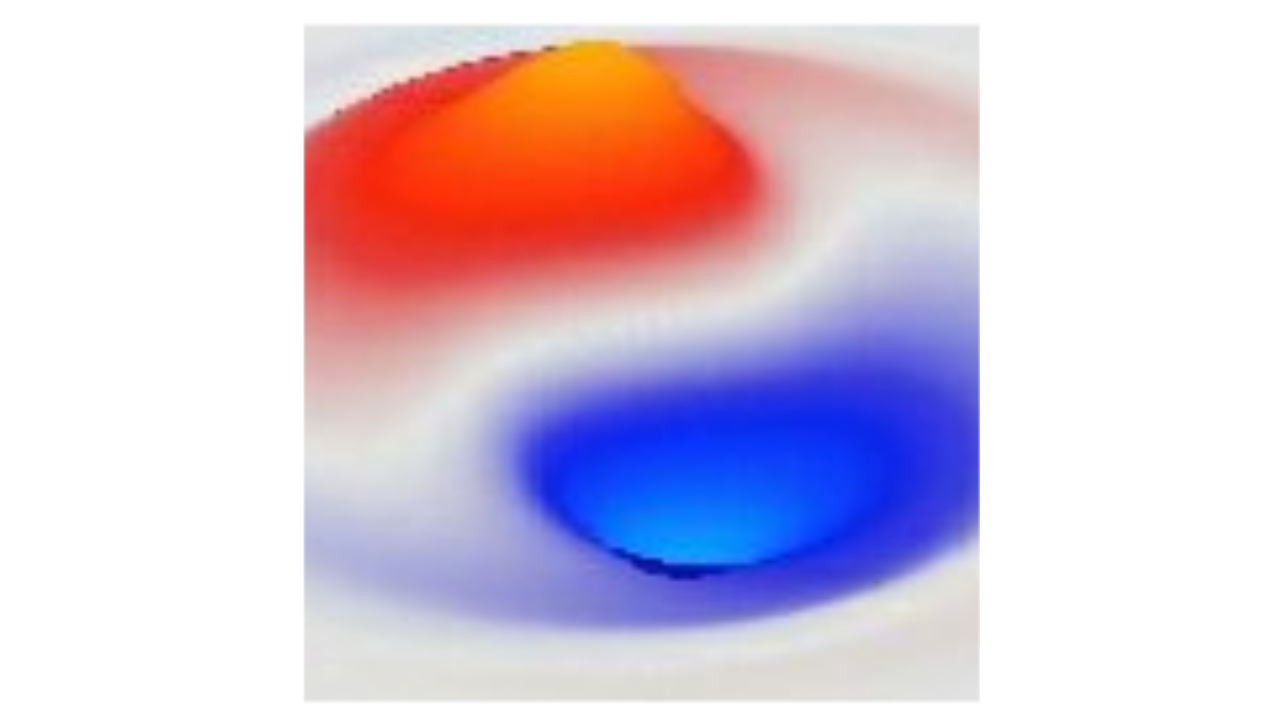
Spin is a uniquely quantum property that is related to what we would intuitively understand in terms of a macroscopic object spinning on its own axis (i.e., angular momentum in physics language). However, it is also quite different, because it applies to quantum particles. Massive quantum particles (fermions) are pointlike, and therefore would not seem to have any “body” that could actually spin. And then there are the waves: spinning waves are actually more well-defined, but still different than you would picture for a hard little ball.
Critically, spin is defined in terms of the internal state of the system, not with respect to some kind of orbiting process around another external body. Therefore, spin provides a really important lens into the internal guts of a quantum entity, and is therefore one of the most important things one needs to understand. However, because these quantum guts are nothing like a macroscopic physical object, you have to approach this concept without any preconceived notions.
There are three values of quantum spin for elementary particles in the Standard Model: 0, \(\pm 1/2\), and 1. Each case is quite different in how it actually arises, and the details of each give you a better understanding of the quantum landscape of spin. In short, spin is not really one consistent thing, even though at an abstract level it has a consistent description:
Spin is how far a full \(360^\circ\) rotation goes toward returning the internal state to its original configuration.
• Spin 0 means that rotation has no effect on the internal state, because the internal state does not have any sense of direction in the first place. The Higgs boson field is the only known example of such a case, which is characterized as a scalar field. Specifically, it is described as a kind of Klein-Gordon wave field with a single real-valued state variable at each location in the field. This is somewhat confusing, because its mathematical basis in the electroweak framework is as the real component of a 4-valued complex doublet state, which should otherwise actually behave as a spin 1⁄2 system. However, due to the spontaneous symmetry breaking that sets the vacuum expectation value of this one component, and the interactions with the other components of the electroweak system, this one field element behaves effectively as a scalar field.
• Spin 1 describes a 3D vector that is pointing in some direction in 3D space, so after 1 full \(360^\circ\) rotation you are back to where you started. This applies to the electromagnetic (EM) vector potential \(A^\mu\) (in four-vector form) from Maxwell’s equations, of which the 3D \(\vec{A}\) vector potential component defines the spatial polarization of a propagating light wave. Thus, this case of spin is a property of the EM field, which exists in its classical definition, and is therefore not a uniquely quantum phenomenon. The other force-field bosons in the weak force are also defined using the same kind of four-vector gauge boson logic (see gauge theory), and presumably the same applies to the strong force as well, so all boson fields are spin 1.
• Spin 1⁄2 is for a more “complex” system with effectively two 2D components (complex numbers) internally, where these components are rotating into each other. After one full \(360^\circ\) “rotation” of this internal state (which is not really visualizable as a physical 3D rotation), the one component has fully rotated into the other, which means that the system is not yet back to its original state. It requires another full rotation for that second component to rotate back into the first. If there was just one complex number, then you could rotate around it fully within one rotation, but because there are two, rotating into each other, it takes twice as long, so you only get half-way around with \(360^\circ\) of rotation.
The spin 1⁄2 case is really the main case of interest here, because the other two cases are relatively easy to understand, and spin 1 is fully classical and well-understood from Maxwell’s equations in terms of the polarization of light.
The spin 1⁄2 fermions in the Standard Model are described using Dirac or Weyl wave functions operating on a complex wave state with two components, which rotate into each-other as a consequence of the Pauli matrices that describe this rotational process. The Weyl description of the electron, where the mass factor links two opposite helicities of rotating states, shows that although there are a total of 4 complex numbers involved in that total state, and in the first-order Dirac equation, the spin factor remains at 1⁄2 because it is really about the underlying two-component states.
The second-order version of the Dirac equation is particularly interesting from a spin perspective, because it ends up being four fully independent second-order Klein-Gordon equations in the absence of any EM field (i.e., four scalar spin 0 fields). In other words, this version of the “guts” of a massive particle says that spin is only manifest through interactions with the EM field, in terms of the effective magnetic moment. It is also true, however, that the Dirac field creates currents that drive the resulting EM field, so they may always be effectively coupled indirectly as a consequence of this.
The magnetic moment is measured in the standard Stern-Gerlach experiments used to measure spin experimentally, but there remains a question as to whether other physically-measurable phenomena might be able to distinguish between these different descriptions (e.g., zitterbewegung).
In addition, the electroweak description of the neutrino is as a single helicity of Weyl wave with no (or extremely weak) mass coupling between the components. Thus, the neutrino also has spin 1⁄2, but no electric charge. Does it still have a spin-like magnetic moment? Theoretically it should (Fujikawa & Shrock, 1980), and experiments are under way to measure it, setting low lower-bounds on its strength.
Consistent with the idea that spin 1⁄2 emerges in the coupling with the EM field, the pilot-wave framework holds that spin is a property of the quantum wave and not of the discrete, localizable particles. This is also consistent with the strongly contextual nature of spin measurements, which are directly shaped through interactions with the measuring device.
Indeed, both spin and polarization (i.e., photon spin) are the typical targets of Bell inequality tests, which depend critically on establishing a superposition state of the variable of interest. Therefore, it is important to better understand in terms of underlying wave equations what such a superposition state of spin might look like, and how it would behave in these kinds of experimental paradigms. Is it literally half of each direction of quantum wave states rotating in opposite directions? Does that have implications for the apparent non-locality detected in these experiments, relative to any other kind of quantum phenomenon?