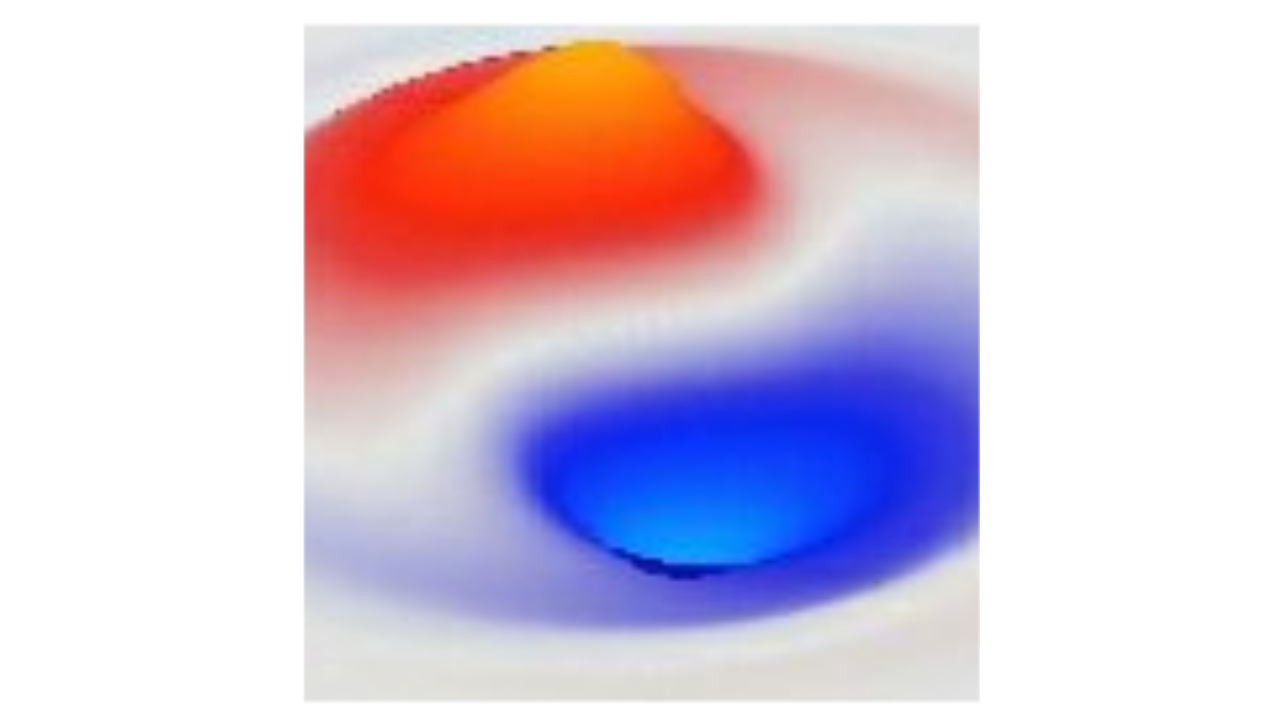
The Weyl equations, developed by Hermann Weyl as a simplification of the Dirac wave function for a spin 1⁄2 particle (fermion) without any rest mass, provide a possible model of the neutrino if it were massless (which it does not appear to be). Because the neutrino mass is very small, it turns out that the Weyl equations nevertheless provide a reasonable approximation, but this remains a major unsolved problem with the current Standard Model.
Furthermore, the Weyl equations are having a bit of a recent comeback in the field theory framework for high-energy situations, where the rest mass is a relatively small portion of the total energy. The simpler two-component nature of the Weyl equations (versus the 4 required for the first-order Dirac equation) turns out to be advantageous in simplifying many important computations, forming the basis for the spinor helicity formalism (Elvang & Huang, 2014).
For our purposes, the key feature of these wave functions (there are two of them, one for each helicity), is that they provide a simpler introduction to the central properties of spin. A critical conclusion is that:
spin 1⁄2 is fundamentally a first-order phenomenon.
At a basic mathematical level, the standard second-order wave equation involves squared quantities, in that a second-order derivative is the repeated application of the derivative operation (derivative squared). This squaring effectively causes the spin 1⁄2 case to effectively rotate all the way around!
This situation is essentially the same as the relationship between the second-order Klein-Gordon (KG) equation versus the first-order Schrodinger equation. KG operates on a single real value, but requires maintaining the velocity in addition to the wave value, while Schrödinger’s equation operates on a complex value. The two degrees of freedom in the complex number essentially map onto the position and velocity variables in the second-order equation.
See complex waves for this and further important analyses of the implications of these differences across the wave functions.
Interestingly, Dirac derived his first-order wave equation directly from the second-order KG equation, by effectively taking the square root. Any time you take a square root, there are 2 solutions of different signs, and this is where the doubling of wave state variables comes from.
Furthermore, the first-order Dirac equation for the electron can be seen as a coupling between the left and right helicity Weyl equations, with the mass factor providing the coupling constant. This provides a distinct way for mass to emerge within a wave equation relative to the second-order KG equation, and is related to the zitterbewegung phenomenon.
In effect, the spinning that happens in the Weyl equations represents a rotation through the two coupled complex wave components:
\[ \psi = \begin{bmatrix} \phi_{1a} + i \phi_{1b} \\ \phi_{2a} + i \phi_{2b} \end{bmatrix} \]
This rotation happens at the speed of light, as the wave itself also propagates at light-speed. The two different helicity variants of the Weyl equations reflect whether this rotation is effectively spinning in a right-hand or left-hand manner relative to the wave propagation direction. You can see this on your own hands, by having your thumb represent the motion direction, and the curled-around fingers represent the rotation direction.
The first-order, right-hand helicity of the Weyl equation in four-vector notation looks like this:
\[ \sigma^\mu \partial_\mu \psi = 0 \]
where \(\sigma^\mu = (1, \vec{\sigma})\) contains the Pauli spin matrices, that provide the essential rotation dynamics:
\[ \vec{\sigma} = \left( \begin{bmatrix} 0 & 1\\ 1 & 0 \end{bmatrix}, \begin{bmatrix} 0 & -i \\ i & 0 \end{bmatrix}, \begin{bmatrix} 1 & 0 \\ 0 & -1 \end{bmatrix} \right) \]
With these, Eq 2 expands to the following:
\[ \frac{\partial \psi}{\partial t} = -c \left( \sigma_x \frac{\partial \psi}{\partial x} + \sigma_y \frac{\partial \psi}{\partial y} + \sigma_z \frac{\partial \psi}{\partial z} \right) \]
so each Pauli spin matrix operates on a corresponding first-order gradient term. When we write it all out, you end up with the following four coupled first-order equations:
\[ \frac{\partial \phi_{1a}}{\partial t} = -c \left( \frac{\partial \phi_{1a}}{\partial z} + \frac{\partial \phi_{2a}}{\partial x} + \frac{\partial \phi_{2b}}{\partial y} \right) \]
\[ \frac{\partial \phi_{1b}}{\partial t} = -c \left( \frac{\partial \phi_{1b}}{\partial z} + \frac{\partial \phi_{2b}}{\partial x} - \frac{\partial \phi_{2a}}{\partial y} \right) \]
\[ \frac{\partial \phi_{2a}}{\partial t} = -c \left( \frac{\partial \phi_{1a}}{\partial x} - \frac{\partial \phi_{1b}}{\partial y} - \frac{\partial \phi_{2a}}{\partial z} \right) \]
\[ \frac{\partial \phi_{2b}}{\partial t} = -c \left( \frac{\partial \phi_{1b}}{\partial x} + \frac{\partial \phi_{1a}}{\partial y} - \frac{\partial \phi_{2b}}{\partial z} \right) \]
The left-handed form of the Weyl equation uses the negative signed Pauli matrices, denoted \(\bar{\sigma}\):
\[ \bar{\sigma}^\mu \partial_\mu \psi = 0 \]
which just causes everything to rotate in the opposite direction.
Relationship to second-order waves
The Pauli spin matrices are defined by the fact that applying them twice gets you back to where you started, which is what creates the alignment between the spinless second-order KG equation and the spinning first-order Dirac or Weyl equations (Brown, 1958; Tonin, 1959; Marx, 1967; Marx, 1970; Case, 1957; Diaz-Cruz et al., 2015; Kibble & Polkinghorne, 1958; Barut & Mullen, 1962; Babin & Figotin, 2014; Cardoso, 1993; Veblen, 1933; Dreiner et al., 2010)
Interestingly, the second-order version of the Dirac equation only involves spin in the context of the coupling with the Maxwell EM field. The components themselves are not spinning into each other.
Thus, the fundamental question is: is spin only revealed in the interaction with the EM field, or is there some more fundamental phenomenon that we’re missing out on in the second-order versions?
The neutrino provides strong indications that a second-order wave function is insufficient to account for observed spin 1⁄2 phenomena. For example, spin is a conserved property, and the emission of an electron and a neutrino during beta decay (involving the weak force) must preserve the total spin. Furthermore, the difference between a neutrino and an antineutrino is entirely in terms of their spin.
Thus, the conclusion from all these considerations is that:
spin 1⁄2 is fundamentally a particle-level phenomenon
Furthermore, the electroweak system requires Weyl equations to capture the SU(2) symmetry structure interacting with the four gauge fields, representing the neutrino and electron lepton variants with the proper helicity asymmetry that results in the well-established parity violation properties of the weak force.
Exploration
See Weyl simulation for a hands-on exploration of neutrinos and electrons under the Weyl framework.