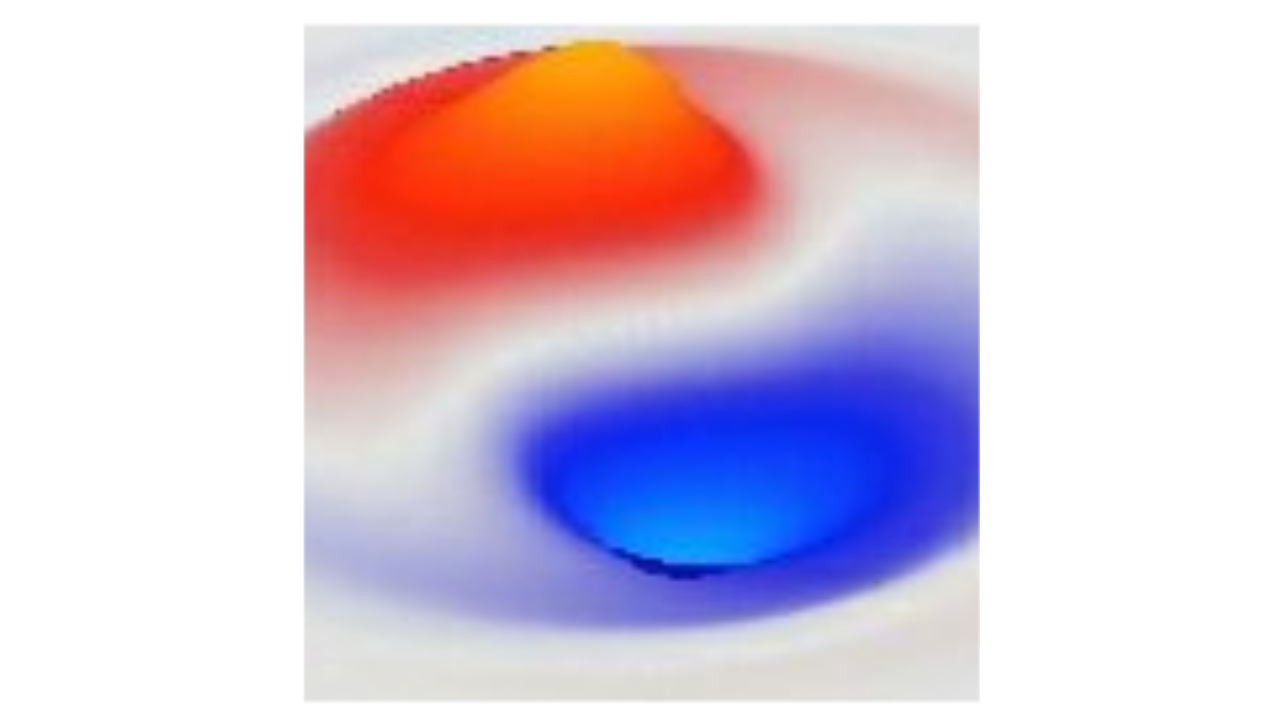
There are two key principles that allow discrete particles in a cubic lattice (as in the cellular automaton framework) to exhibit fully continuous, isotrophic motion:
• Stochastic Brownian movement enables a discrete particle to exhibit macroscopically continuous, isotropic overall behavior, based on the original work of Nelson (1966), Ord (1996), and subsequent work by Sciarretta (2018); Sciarretta (2021) and others reviewed therein. The key intuition is that random timing and directions of discrete jumps can result in isotrophic, fully graded macroscopic motion trajectories.
Furthermore, this motion naturally exhibits the main properties of the quantum wave function (e.g., the Schrodinger equation as shown by Nelson, 1966), where a slow drift rate produces a wide cloud of space where particle could be, corresponding to a long wavelength in the probability cloud that the Schrodinger wave function describes. However, when the particle has high momentum, it moves more deterministically in a given direction, resulting in a narrower range of variance around the particle’s mean trajectory, resulting in a narrower effective wavelength (Figure 1).
Thus, unlike the pilot-wave framework, the quantum wave function in a purely stochastic particle model is entirely epistemic: it just describes the expected value of a discrete particle’s random walk trajectories over time. There is no physical reality to such a wave.
While this is appealing in its simplicity, it does not appear to provide an explanation for phenomena such as the double-slit experiment, where somehow a particle can interfere with itself, but only if the other slit is open. Furthermore, it cannot be the case that these interference effects only arise in the rare cases when a discrete particle happens to wander so aimlessly as to go through both slits somehow.
• Discrete particles require some other continuous state values embedded in the same discrete lattice to drive the probabilities underlying their stochastic behavior. The nature of such values is often unaddressed in existing frameworks. The pilot-wave framework of de Broglie and Bohm provides a natural mechanism for these continuous momentum values, where the continuous-valued wave function guides the motion of a discrete particle in some way.
Figure 1:
Stochastic origin of quantum momentum / frequency relationship. The momentum on the left is 0.5c while on the right is 0. The distribution of position is on the vertical axis, while time is on the horizontal axis, with each point centered at the origin in the center (i.e., the temporal autocorrelation function). The variance on the left is half of that on the right.
Overall, the discrete particle framework does a great job of keeping the accounting tight, in comparison to the fundamentally sloppy matter waves that end up diffusing over time and space. The discrete particles can be strictly conserved, and always tightly localized, while the surrounding wave functions diffuse outward from this central island of stability.
However, a system based purely on discrete particles has a very hard time managing interactions among the particles via forces: the odds of any other discrete particle “hitting” another are very small, whereas these big sloppy waves provide a nice continuous, broadly diffusing and saturating medium for force transmission. In effect, the surrounding wave field is essential for the particle to be able to properly “sense” the force field effects (from electromagnetic, weak and strong forces). Thus, the wave field functions like an antenna or “whiskers” in sensing forces over a broader space, beyond its own singular cell.
From a “design” perspective, this hybrid framework of discrete particles and continuous wave fields represents a “best of both worlds” solution, relative to something based exclusively on discrete particles, or exclusively on continuous wave functions. This then provides a compelling reason for the otherwise central puzzle of the quantum world: why is there this wave-particle duality? Why is nature so strangely complicated in this way?
Relative to the standard QM interpretations, the pilot-wave nature of this approach avoids all the impossible conundrums of instantaneous wave collapse at the point of measurement, as the discrete particles are there at every point in time and space, even when you’re not looking. The primary challenge for such a framework is dealing with the apparent non locality of quantum entanglement.
Remaining degrees of freedom
Within this broad framework of discrete particles interacting via continuous waves, there are many degrees of freedom in specifying the details, in a way that ends up being physically accurate. Here are some of the primary questions:
• An original inspiration for the stochastic particle approach was Feynman’s path integral approach to QED, which is based on the idea that every possible pathway is somehow being sampled with an associated probability, via virtual particles that are only transiently extant. This “quantum foam” provides a different kind of picture relative to a lone “real” discrete particle bumping around in space. Instead, at every moment, particles are constantly popping into and out of existence, most with tiny probabilities, and this is what shapes the behavior of the “real” particles that are observed.
The key question here is whether the continuous wave function plus stochastic behavior in a real particle ends up capturing everything that is otherwise captured by the virtual particles? From a complexity management perspective, it makes sense in any case to start with the much simpler frameork of the known Dirac wave function operating on a real electron, and see how far that goes.
• How does the particle influence the wave fields? This is the back reaction question that has long bedeviled attempts to understand the detailed “mechanistic” physics taking place up close around a charged particle (Ford & O’Connell, 1991; Ford & O’Connell, 1993). Specifically, very near the particle itself, the electromagnetic potential would be very strong, and thus correspond to a very high energy density, which should then end up producing virtual particles etc. This is known as the ultraviolet divergence problem. It can be “solved” by having some kind of cutoff at short length scales, but that seems fairly arbitrary. Also, as the particle moves discretely to neighboring grid points, that creates ripples in the force field.
One solution, consistent with the pilot-wave approach, is that the discrete particle itself doesn’t actually generate any back reaction, and is instead purely a “surfer” on the waves. This would imply that the Dirac field itself would generate the corresponding Maxwell EM field, which also solves many conceptual difficulties because it is smoothly distributed over space. In short, the same arguments that favor the Dirac field as a kind of antenna for the force field also apply in the reverse direction, for the generation of force fields from charged matter.
However, the Dirac field itself is likely representing both epistemological vs ontic contributions to overall uncertainty. So in principle, the actual current location of the particle should be driving updating of the Dirac field. But there is little in the way of existing guidance for how this might happen. Mathematically, this should be just like the state right after a particle has been localized to one point, but then the momentum is gone. Considerable work needs to be done investigating useful continuous momentum wave functions that can be driven by the localization of a discrete particle.
A further wrinkle is the possibility that particles leave some kind of trace on the wave field that then influences subsequent particles, as a way of explaining the apparent non-locality phenomena (Sciarretta, 2018; Sciarretta, 2021).
• Hidden particle states. The Ord, 1996 model involves 2 state variables for each particle, that correspond qualitatively to the spin degrees of freedom in a fermion particle. The Dirac equation in its second order formulation likewise has 4 wave state variables that mutually interact to produce spin, via the spinor dynamics. These also produce the phase dynamics of quantum wave functions, and are important for the conservation properties of these functions. Thus, the possibility of these internal state degrees of freedom, beyond just a single binary state value, must be properly explored, especially as it might interact with the Dirac spinor states.
One intuition is that the resting energy / mass of a particle is associated with this constant cycling through the spin states, and that somehow this cycling dynamic within a single cell is capable of maintaining some kind of momentum value, as it couples with the Dirac-like wave state that it is generating. This may be related to the phenomenon of zitterbewegung (Hestenes, 2008; Hestenes90]; Sidharth, 2009; Roman et al., 2003; Barut & Bracken, 1981; Wang & Zhang, 2001). Thus, the actual momentum represents a spatial imbalance in this constant internal spin motion within the particle state.
One tempting idea in this space is that you could somehow imagine a spatially distributed collection of “sub states” for each particle, kind of like a very compact localized wave function. However, once you stray outside of a single discrete cell, it becomes logistically very difficult to keep track of these distributed states, and preventing them from leaking out all over the place.
The initial specific model here would involve at least two values for each cubic 3D axis (6 total), plus two for the “staying still” component, and the relative balance between the values along each axis determines the net momentum along that axis. These values are then updated in response to the gradient along each such axis, computed across the 26 point cubic neighborhood as usual (discrete gradient). The same technique as used in the Klein-Gordon and Dirac wave functions, where the mass term drags against the wave-based oscillation frequency, could be used to obtain the fundamental quantum frequency relationship.
• Multiparticle states are also an essential constraint on the system. The wave state variables must be shared across all particles of a given type (otherwise you’re back in configuration space), but if they are holding important state for an individual particle, then how does that work when another particle’s wave function gets close by? For example, if it is spinning the other way? Does that interfere with the spin of the other guy? This is also a good reason to keep the wave function less widely distributed, as should happen when the particle is the generator.
• The particle zoo: muon and tau vs electrons, antiparticles, neutrinos are “pure spin” without any charge. All of this suggests that charge and spin are two separate factors that could potentially dissociate, but yet stick together. Neutrinos are always left-handed, and anti-neutrinos are right-handed: this is a key constraint on the nature of spin and mass. Charge gives rise to (lots of) mass, but spin does not (much)? Maybe just kinetic energy in spin? The spin model should definitely accommodate neutrinos. Also, they have muon and tau flavors. So overall, this all sounds like a factorizable dynamic system.
The muon decays after an average lifetime of 2.2 millionths of a second into an electron, a neutrino, and an antineutrino. Ok, so the muon is somehow a regular electron plus these two additional neutrinos worth of spin? And that adds up to 200x the rest mass of the electron, and yet the neutrinos themselves are nearly massless! And all of this is tied up with the weak force, which must then be considered. Perhaps the short-range nature of this force plays a critical role in the localized stochastic dynamics. Also, the random nature of weak-mediated decay processes is broadly consistent with the true randomness required here.
Overall, this is a relatively large space to explore, and there are many potential tradeoffs in terms of the risks of taking on too much versus, paradoxically, too little, where it may be the case that adding additional complexity (e.g., in the form of the quantum foam of virtual particles and multiparticle states more generally) solves problems that would otherwise plague simpler, reduced, single-particle frameworks.
Photons
Unlike fermion particles such as electrons, the EM field is not amenable to a discrete particle-like framework: photons have many problematic issues as discrete particles of the EM field. Therefore, it makes more sense to retain a “classical” Maxwell EM field, interacting with the discretized fermion cells, as in the semiclassical approach developed by a number of researchers (see Struyve, 2020; Santos, 2015).
Virtual particles, the discrete lattice, and probability waves
Virtual particles are an essential feature of QED / quantum field theory, and yet their “ontological” status is clearly somewhat confusing: they aren’t the “real” particles that we observe, and yet their fleeting existence is necessary for the theory to work, so in some sense they must be just as real as the “real” particles.
The discrete particle lattice framework provides a potential resolution to this conundrum. If any given “real” particle can potentially occupy any given cell in a discrete lattice, then there must effectively be a “slot” reserved for such a particle in each cell. These empty slots could provide an appealing basis for virtual particles, and the propagation and interactions of particles in the matrix.
In particular, a simple schema is that the probability waves associated with the standard interpretation of QM reflect a rippling propagation of probability factors across virtual particle slots in the matrix, with a real particle having a special status as being the current “true” location. Each possible jump to a neighboring cell involves a full transition matrix dependent upon the total energy (mass + kinetic) of the source: if the source is sufficiently energetic, it has some probability of activating a different combination of real particles as it makes the leap, accounting for the splitting tracks observed in particle accelerator experiments. Perhaps some of the “trace” in the matrix represents residual bits of this probability field propagating out and being left behind as real particles move around.
It is essential that these probability computations are all propagated in terms of amplitudes, not the probability values themselves, which are obtained by the product with the complex conjugate (“squaring”).
TODO
- • zitterbewegung and helical spin in electron: Hestenes, 2008; Hestenes90]; Sidharth, 2009; Roman et al., 2003; Barut & Bracken, 1981; Wang & Zhang, 2001