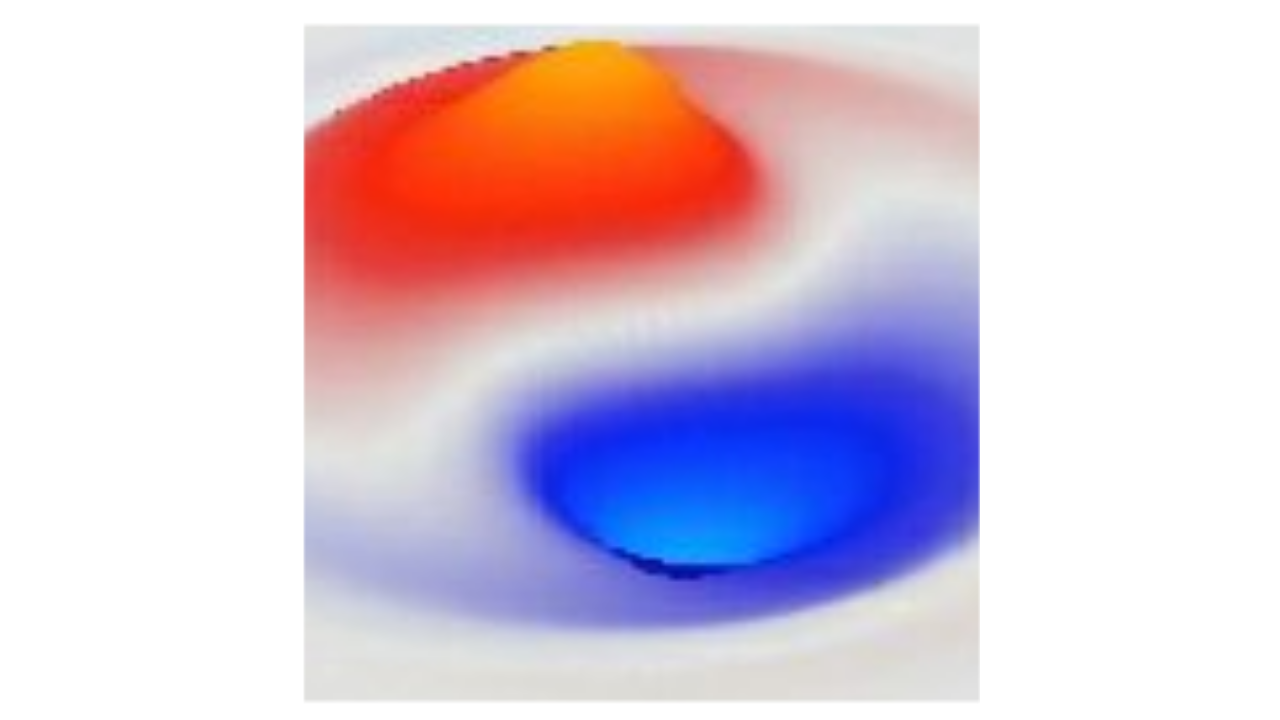
Dirac Simulation
From units
Config • ViewInterval
Config • Wavelength
Config • PacketWidth
Config • PacketSlab
Config • Amplitude
Config • HydrogenRadius
Config • OscillatorPeriod
Params • Edges
Fixed
Wrap
Damp
Params • Energy
Params • C
Params • Hbar
Params • Mass
Params • EM
Params • SelfField
Params • A0NoWave
Params • E
Params • Mu0
Params • Boris
Units
Units
GUI
GUI
Update
Panel:
Plane
ZeroCtr
Current
Counters:
Move:
Rot:
Pan:
Save:
Open CSV
Filter
Unfilter
This simulation runs the Dirac equation in 3D.
This builds on the complex KG simulation, with more complete spin-based coupling with the Maxwell EM field. Use the sim_dirac:Root Stats Plot to view the Charge value and other key stats.
The single most important qualitative phenomenon to observe is how spin in this set of four second-order wave equations emerges only through the coupling with the EM field, and is otherwise not present in the free electron. You can observe this by comparing Spin at Rest with Spin Precession as described below: in the first case, there is no EM field, and the A2s wave remains inactive (it is initialized to 0). In the latter case, there is an EM field, and the A2s spins relative to the A1s etc.
The sim_dirac:Config initial configurations are as follows:
• Spin at Rest: A lump of charge at rest with spin along Z; nothing happens to the spin, because a free particle has no effective spin, which only emerges through coupling with EM field.
• Spin Packet: A travelling spin-1⁄2 packet along X (as in other wave packet cases), showing the effects of spin and mass relative to basic wave.
• Spin in Potential: An electron lump offset from a fixed 1/r well, pulled in by it: the external-field case, with SelfField off so A0 stays as set.
• Spin Precession: Spin along X in a uniform B magnetic field along Z: it precesses at the Larmor rate with g = 2; look at the SigX and SigY values in the stats plot.
• Dirac Hydrogen... simulates an electron in an S or P orbital configuration within the hydrogen atom, where the positive charge provides the attractive force.
• Dirac Oscillator: simulates the quantum harmonic oscillator using Dirac waves.
• Chiral Oscillation: A lump started purely right-chiral: the mass turns it into the left one and back at m c^2 / hbar, which relates to the Weyl version where mass mediates conversion back and forth.