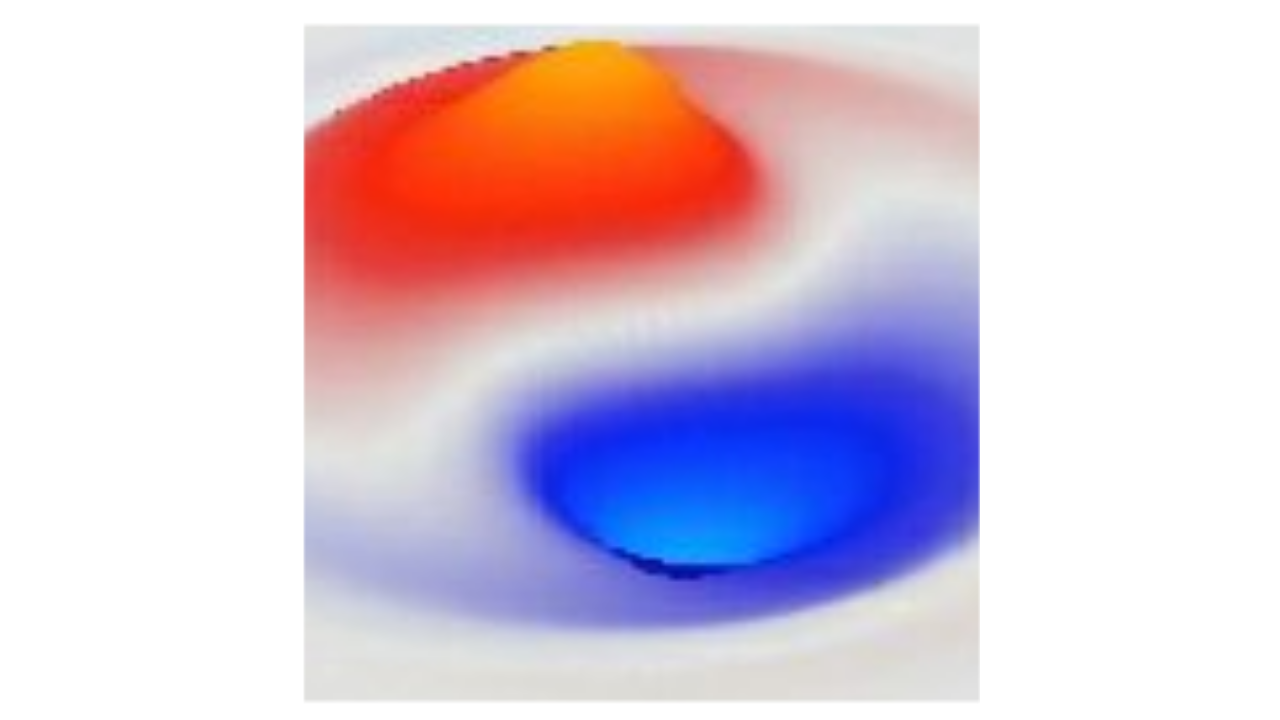
Zitterbewegung
The phenomenon of zitterbewegung, which means “bouncing back and forth” in German, was originally proposed by Schrödinger (1930), as a very high-frequency vibration at twice the Compton frequency (see planck relation) (Hestenes, 1990). It is largely beyond current experimental techniques to measure (e.g., frequency of around \(2.5 \times 10^{20}\) Hz), but some indications have been observed (Gerritsma et al., 2010; Qu et al., 2013).
The Weyl equations for an electron exhibit strong zitterbewegung oscillations in terms of a coupling between two first-order helical waves, while the second-order Dirac description ends up being four fully-independent wave equations, which only spin in the presence of an EM field. Thus, it is possible that empirical detection of zitterbewegung could discriminate between these two descriptions of the electron.
Furthermore, the de Broglie version of the pilot wave framework, where the particle serves as a source input driving the wave oscillation, predicts such a phenomenon as well (Dagan & Bush, 2020).