
Uncertainty principle
The uncertainty principle articulated by Werner Heisenberg is a basic property of any wave, under the Hamiltonian interpretation of the wave properties in terms of momentum and position operators.
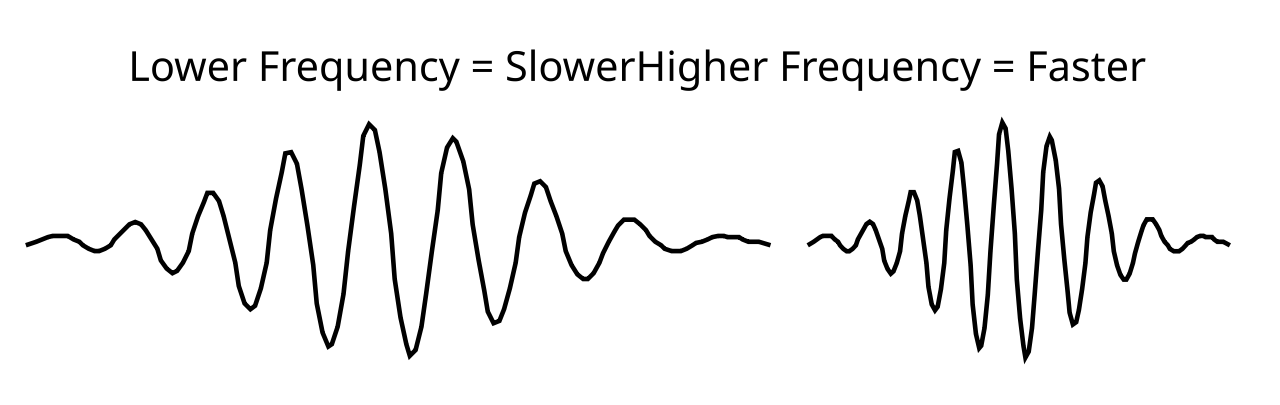
Figure 1: Relationship between frequency and speed in the Klein-Gordon (KG) wave function, which derives from competition between the “mass drag” and the overall curvature of the wave. Higher frequency waves have more curvature and thus move faster.
Specifically the property of a wave function that corresponds to momentum is proportional to the frequency of the wave (Figure 1), while more precisely encoding the position depends on having most of the wave amplitude concentrated into a narrow region of space.
These two properties are complementary (canonically conjugate), because frequency is only precisely well defined for an infinite sine wave, and becomes increasingly imprecise as the wave amplitude is concentrated into a narrow range of locations. But the converse is true for position, as noted above. So as you improve the quality of the momentum encoding in a wave, it necessarily degrades the position information, and vice-versa.
This can be expressed in the following inequality:
\[ \sigma_x \sigma_p \geq \frac{\hbar}{2} \]
Where \(\sigma_x\) is the uncertainty (standard deviation) of position, and \(\sigma_p\) is the uncertainty in momentum, and the best-case scenario is that their product is equal to the reduced Planck constant \(\hbar\) over 2. As one goes down, the other must go up to maintain this relationship.
This uncertainty ultimately derives from the contextual nature of the quantum world: we cannot measure the state of the system without irrevocably altering this state. And this is all because the state is made in part of waves, which are fundamentally “squishy”, distributed things that don’t sit still and are impossible to measure without disturbing them.