Planck relation
The Planck relation is one of the most important, simple equations in all of quantum physics, specifying the relationship between energy E and wave frequency f, in terms of Planck’s constant h:
\[ E = h f \]
The relationship between wavelength and frequency also contains a speed-of-light factor:
\[ \lambda = \frac{c}{f} \]
So the wavelength as a function of energy is:
\[ \lambda = \frac{h c}{E} \]
For a particle at rest, the energy is a function of its rest mass \(m_0\):
\[ E_0 = m_0 c^2 \]
Which determines a corresponding frequency:
\[ f_0 = \frac{m_0 c^2}{h} \]
And a wavelength, known as the Compton wavelength:
\[ \lambda_0 = \frac{h}{m_0 c} \]
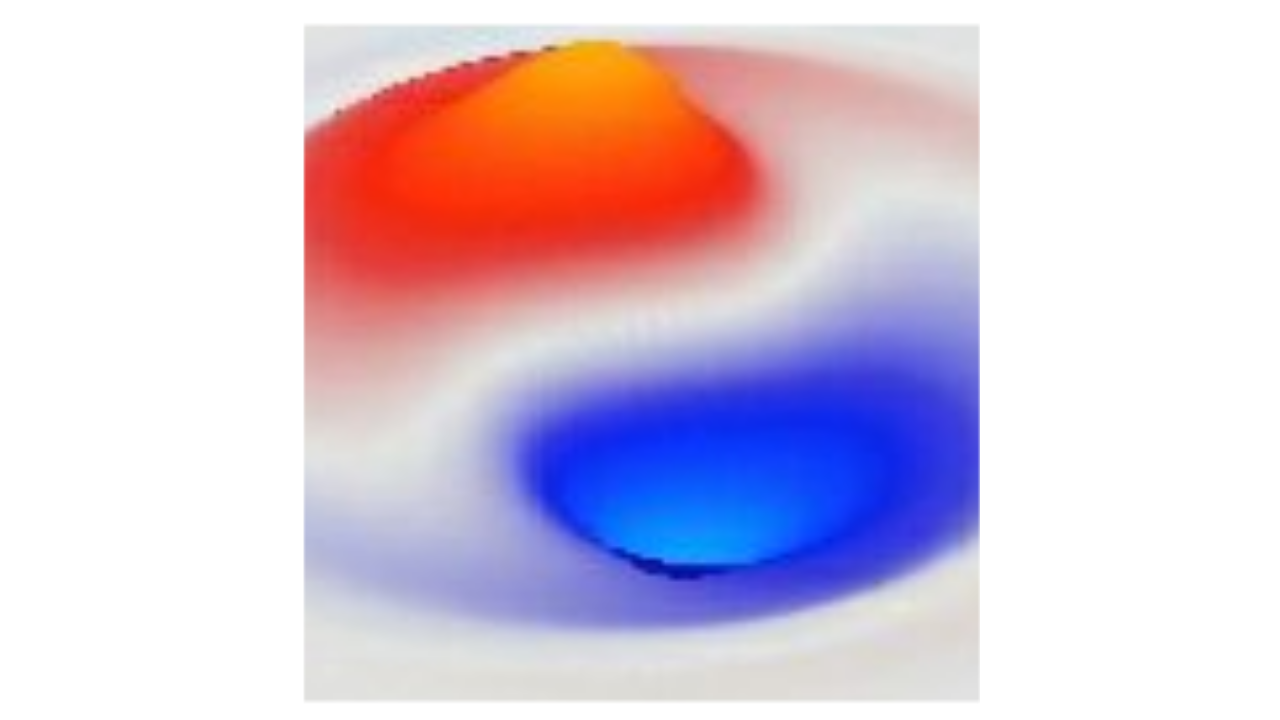
In the pilot-wave framework, the quantum wave vibrates at this wavelength. The approximate length scales for different particles are shown in Table 1. The proton is a composite of 3 quarks, with an estimated charge radius of \(8.40 x 10^{-16}\) m, which is smaller than its Compton wavelength by mass.
Table 1: Compton wavelengths
| Particle | rest mass (MeV/c^2) | wavelength (m) |
|---|---|---|
| electron | 0.51 | \(2.43 x 10^{-12}\) |
| muon | 105 | \(1.17 x 10^{-14}\) |
| tau | 1,777 | \(6.98 x 10^{-16}\) |
| proton | 938 | \(1.32 x 10^{-15}\) |